

From our quay to yours
How a sack of sesame in a Tanzanian warehouse becomes a sealed container on a ship leaving Durban, and which part of that journey you pay for under each Incoterm.
The Durban advantage
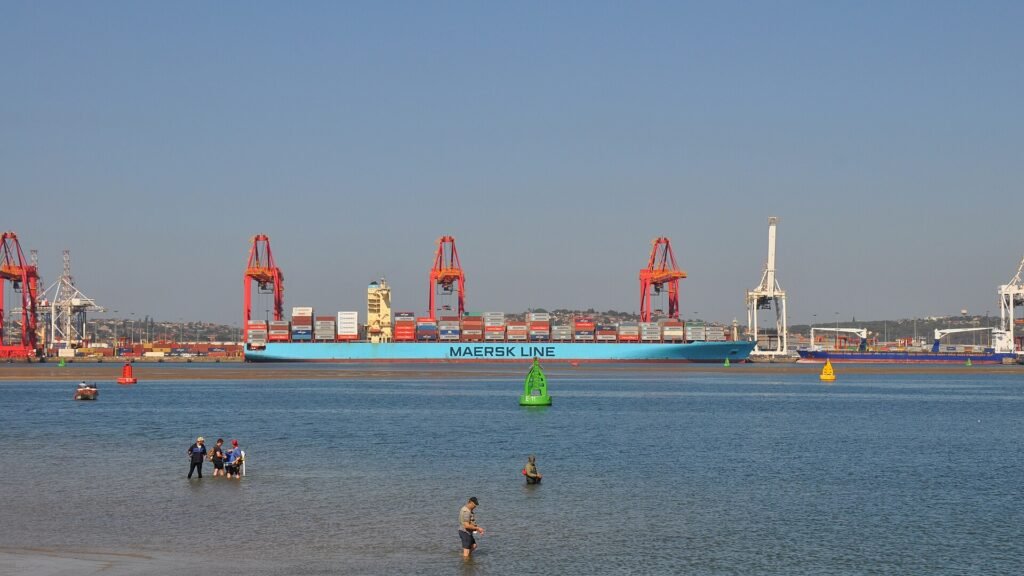
Durban is the busiest container port in sub-Saharan Africa. For our buyers that means three practical things.
- More sailings, more routing choice. Direct and transhipment services to the Gulf, the Indian subcontinent, East Asia, Europe and the Americas.
- Depth of services. Fumigators, surveyors, laboratories, flexitank fitters and clearing agents all work within a short drive of the terminals.
- One consolidation point. Cargo from South Africa and, where it makes sense, from neighbouring countries is brought together and loaded under one set of documents.
How we ship
The commodity decides the vessel space. These are the three ways cargo leaves us.
Dry containers
20ft and 40ft boxes for bagged, cartoned and baled cargo: nuts, pulses, spices, sugar, coffee, fertiliser and sisal. Lined with kraft paper and desiccant where moisture matters. Reefers for apples.
Flexitanks and ISO tanks
Single-use food-grade flexitanks hold roughly 20 to 24 MT of oil in a 20ft container. ISO tanks suit heated oils and repeat lanes. Drums and IBCs for smaller lots.
Bulk and break-bulk
Large fertiliser, sugar and grain parcels can move in bulk or in jumbo bags on break-bulk vessels. We quote these case by case, with a surveyor at loading.
Incoterms 2020
Who pays for what, and when the risk moves
We quote three terms. Under all three, risk passes to you once the goods are on board the vessel in Durban. What changes is who pays for the sea freight and the insurance.
Export documentation checklist
Drafts reach you for approval before originals are issued. Originals travel by courier or electronically, as your bank or customs broker requires.
- Commercial InvoiceValue, Incoterm, HS code and banking details.
- Packing ListUnits, net and gross weights, marks and lot numbers.
- Bill of LadingIssued by the carrier once cargo is on board in Durban.
- Certificate of OriginThrough the chamber of commerce or as your trade agreement requires.
- Phytosanitary CertificateIssued by the national plant protection authority for plant products.
- Certificate of AnalysisLaboratory results against the contract specification.
- Fumigation CertificateFor pulses, nuts and other stored products where required.
- Inspection CertificateSGS or an equivalent surveyor on request: quality, weight and loading.
Inspection and lead times
Every lot is checked by our own team before packing. For independent verification we appoint SGS, Bureau Veritas, Intertek or a surveyor you name, who samples, seals and photographs the cargo during stuffing. Costs are quoted upfront and agreed in the contract.
Typical lead time from confirmed order and agreed payment terms to loading is 2 to 5 weeks, depending on the crop, the season and the grade. Each product page gives its own estimate.
Indicative transit times from Durban
| Region | Example ports | Days at sea |
|---|---|---|
| East Africa | Dar es Salaam, Mombasa | 5 to 12 |
| Middle East | Jebel Ali, Dammam | 14 to 22 |
| Indian subcontinent | Nhava Sheva, Chittagong | 16 to 26 |
| East Asia | Shanghai, Qingdao, Busan | 22 to 32 |
| Southeast Asia | Port Klang, Ho Chi Minh City | 18 to 26 |
| Europe | Rotterdam, Antwerp, Hamburg | 24 to 34 |
| West Africa | Tema, Lagos | 18 to 28 |
Port to port, indicative only. Actual times depend on carrier, routing and transhipment, and are confirmed on booking.
Your order's journey
Eight stops between your first message and your cargo release.
Enquiry
You send product, grade, quantity and port by form, email or WhatsApp.
Offer and sample
We confirm specification, price, Incoterm and validity. Samples on request.
Contract
Sales contract signed, payment terms and inspection agreed.
Sourcing and grading
The lot is assembled, cleaned and graded to contract.
Packing and inspection
Bagged or tanked, marked, and inspected if you asked for it.
Stuffing in Durban
Containers loaded, sealed and photographed, then gated in.
Documents
Drafts approved, Bill of Lading issued, originals released per terms.
Arrival
Your broker clears the cargo with the documents we supplied.